
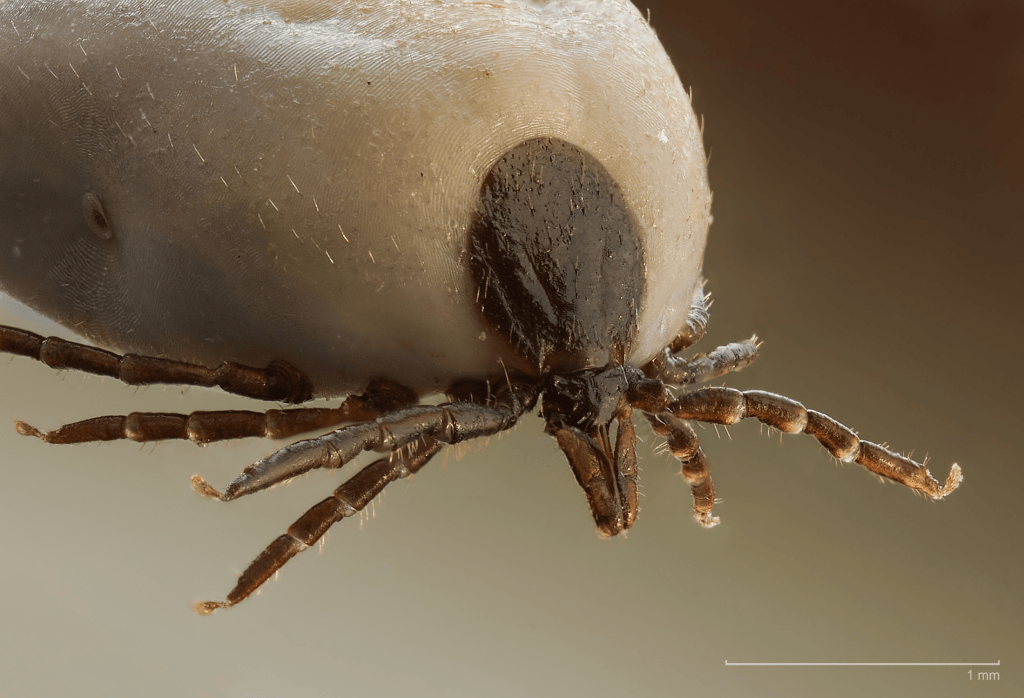
How does a tick feed? What allows it to use hosts as endless blood supplies? Most importantly, how do you kill a tick?
Ticks are everywhere. We see them on every walk through High Park and neighbourhood trails. Waiting in tall blades of grass for unsuspecting victims, they feed on mammal blood indiscriminately while striking fear into pet owners and parents alike. But how does a tick actually feed, and why are they so hard to kill? How did they become so widespread? This article explores one of our fastest-growing blood-sucking pests and what actually works when dealing with ticks.
Unlike other pests like the mosquito or the even more infamous bed bug, ticks intentionally stay on your body for long periods of time, usually by piercing and burrowing into the skin. . The first of these torture mechanisms are the chelicerae, which live on the tick’s “false face.” They work almost like a saw to open up the unlucky mammal’s skin. Then, the hypostome—a sort of needle in the tick’s mouth—acts like barbed wire, sliding through the opening the chelicerae created, and latching the tick onto its unsuspecting host. Pedipalps are sensory feelers that guide the mouthparts, tracking the host’s skin and helping the tick adjust its position. This is how the tick’s finely evolved mouth allows it to remain on its victims for long periods of time—until it becomes so engorged with blood that it drops off the body. Talk about a greedy tick!
Why is everyone talking about ticks? Though these vicious little bloodsuckers are not fun to interact with, there might be more myth than truth to the idea that every tick is carrying a deadly disease. One thing many people get confused about is whether ticks in Ontario can transfer Lyme disease. Though some blacklegged ticks do have the potential to be carriers, they are just one of the many tick species found in Ontario, and most other species do not transfer Lyme disease. Furthermore, a tick generally needs to be attached for more than 24 to 48 hours before Lyme disease can be transmitted. If you catch and remove it before then, the likelihood of infection is very low. So yes, ticks can transmit disease, but they are not as scary as you might think.
Finally, let’s clear up any confusion about what to do if you find a tick on yourself or your pet. First, never crush or squish it with your fingers: a disturbed tick can regurgitate gut fluids into the wound. Go home and grab a pair of fine-tipped tweezers. Grip the tick as close to your skin as possible and pull it straight out, without twisting. If the tick’s head breaks off and stays behind, don’t panic; wash the area with soap and water and watch for a rash. Most importantly, after it’s removed, flush the tick down the toilet or, if you’re not near one, put it in a plastic bag and crush it.
Tick season might frighten you, but it’s mostly a trick. Don’t be fooled by the noise these minuscule torture bugs have caused. Though some ticks can be dangerous to our pets and (occasionally) to us, a little knowledge and a good pair of tweezers can go a long way.