
Ontario wildfires and forms of resistance to Bill 5
This July, Torontonians woke up to a dystopian view outside of their apartment windows; orange, hazy skies held thick smoke over the city skyline. Headlines on phones and computers read that “Toronto’s air quality has ranked the worst among all major cities in the world.” Environment Canada issued warnings that the Air Quality Health Index had reached over ten, asking people to limit their time spent outdoors. Many took to social media, trying to figure out what was going on, with hundreds of comments flooding Reddit threads with concern and suggestions.
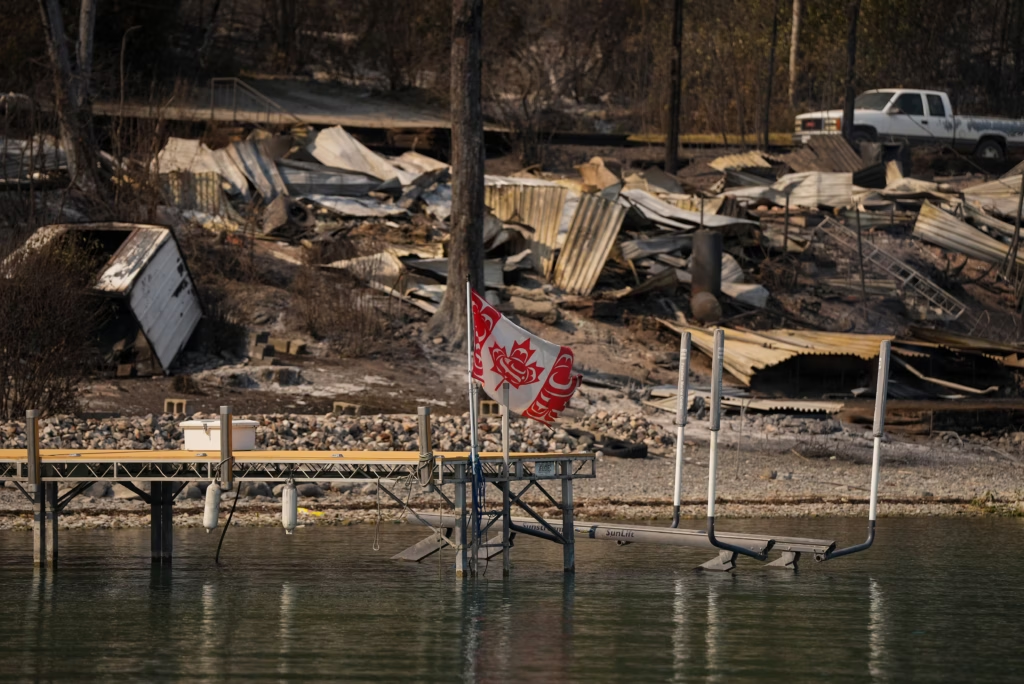
News stories have focused on statistics showing that Toronto’s air quality ranked worse than that of New Delhi. Toronto is a less populated and typically less polluted city than New Delhi, so for it to have the worst air quality in the world signals the growing frequency and thus impact of wildfires. For most Torontonians, wildfires have never impacted their daily life so intensely. However, in more remote areas, wildfires have demolished entire communities and caused thousands to be displaced this summer alone. For years, wildfires have disproportionately uprooted the lives of First Nations communities in Canada; these same communities are not given enough agency in crucial climate decisions even though they are often primary stakeholders.
Wildfires and First Nations in Canada
People around the world were connected with these remote communities when a video went viral of train conductors surrounded by flames near Armstrong, Ontario. In Northwestern Ontario, the fires have been especially bad this year. First Nations communities near Thunder Bay, Sioux Lookout and Dryden have been evacuated from massive approaching fires. More than 1600 people from these communities remain displaced.
Though the extent of wildfires in Ontario this summer might be exceptional, the disproportionate evacuation of Indigenous people in Canada is not a new trend, and is becoming worse. Though First Nations people are about five per cent of Canada’s population, they make up 42 per cent of wildfire evacuations. Government statistics also show that the wildfire impact on First Nations reserves is increasing significantly each year.
Democracy and Climate Policy
Recently, protestors in Toronto celebrated the success of the NoJetsTO movement; Ontario Premier Doug Ford’s plan to designate Toronto’s waterfront as a Special Economic Zone (SEZ) to accommodate jets at Billy Bishop Airport was undermined. Premier Ford’s plan for Toronto’s waterfront was made legally plausible by the passing of Bill 5 in June, 2025. This bill allowed for the establishment of SEZs; regions hosting infrastructure projects that the province can deem exempt from municipal and provincial regulations in order to speed up the development process.
Within weeks of the passing of Bill 5 on June 5, 2025, Webequie First Nation was nearly burnt down by a wildfire. For Chief Wabasse of Webequie, this incident only emphasized the benefits that an all-season access road would bring for his community – a region over 500km north of Thunder Bay that was only accessible by land via a winter road. Webequie, alongside Marten Falls First Nation signed agreements with the provincial government in the fall to build access roads adjoining the Ring of Fire mining project.
The Ring of Fire, a critical mineral-rich area in Northern Ontario, has been one of Premier Ford’s major SEZ designation targets, which has been heavily disputed by surrounding First Nations. Fourteen First Nations have joined a legal challenge of Bill 5 altogether, with Neskantaga First Nation physically blocking the construction of the Northern Link access road. Crucially, even though Premier Ford repeatedly included Marten Falls in the group of people who want to “get it done” when it comes to SEZs for mining the Ring of Fire, Chief Bruce Achneepineskum explicitly responded that he was “not OK with [Bill 5].”
The leaders of Webequie and Marten Falls were caught between the economic benefits to their communities and risking environmental damage to the land that surrounds them. However, since signing Ring of Fire agreements, these Nations have taken environmental regulation into their own hands, with Webequie leading their own environmental impact assessment for the access road.
After the success of the NoJetsTO movement, Toronto Mayor Olivia Chow commented that “democracy matters, those voices matter. And when they spoke with one voice, don’t touch our waterfront, protect it, it matters.” For Indigenous communities that have been disproportionately damaged by the impacts of wildfires and climate change, the relationship between environmental regulation, democracy and socioeconomic prosperity can be complicated. Bill 5 has been heavily protested in Toronto, but resistance to Bill 5 up north has taken place not only through law, but also through independent environmental assessments and blockade village-building.